Reading with Vision Loss: Braille, Large Print, and More

There’s something irreplaceable about getting lost in a good book. It connects us to ideas, to other people’s stories, to the wider world. That doesn’t have to change when your vision does. Today, people who are blind or have low vision have more ways than ever to keep reading, and the right format is often just a matter of finding what fits your life.
Why This Matters
Losing vision later in life can bring a real sense of isolation, especially when the things you used to love, like curling up with a book, suddenly feel out of reach. Adults 65 and older living with vision loss report nearly double the rate of anxiety and depression compared to their sighted peers. Reading isn’t just a pastime; it’s a connection to community and a source of mental well-being. One long-term Yale study even found that people who read books regularly lived, on average, nearly two years longer than non-readers.
The good news: vision loss doesn’t mean the end of reading. It means finding a new way in.
Braille: A Foundation of Literacy
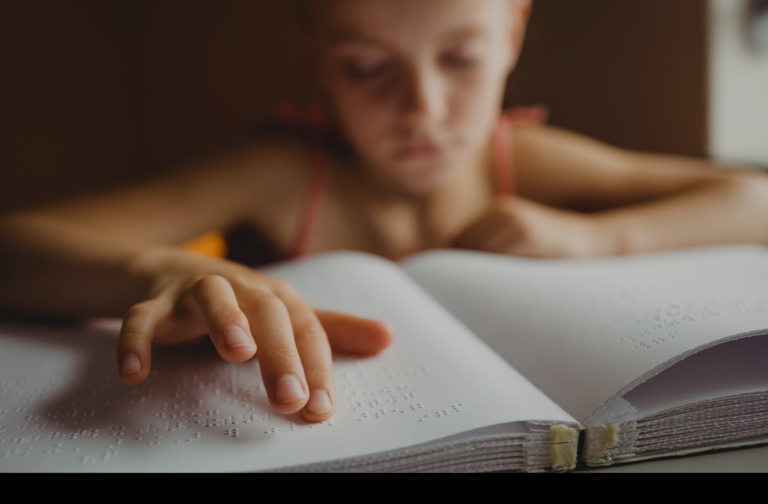
Braille has given people who are blind a path to literacy for nearly 200 years. It’s a tactile system of raised dots, arranged in patterns called cells, read by touch. Braille isn’t limited to novels. It covers music, math, and just about every subject you can imagine, and it’s increasingly available on digital braille readers as well as paper.
Large Print: More Than Just Bigger Text
Large-print books aren’t simply a standard page blown up. Publishers who specialize in this format carefully choose typeface, spacing, layout, color contrast, and paper type. They usually enlarge body text to 18-point and headlines to 20 to 22-point, making reading genuinely easier on the eyes, not just larger.
Talking Books: A Different Way to “Read”
Talking Books are often confused with audiobooks, but they’re not the same thing. Talking Books are funded publicly and provided at no cost to people with blindness, low vision, or other disabilities that make reading print difficult. They’re also cataloged in braille, which standard audiobooks are not.
The National Library Service for the Blind and Print Disabled (NLS), part of the Library of Congress, runs the largest free braille and audiobook library in the country. Their BARD program (Braille and Audio Reading Download) lets you download books and magazines straight to a phone, tablet, or computer, or listen through an affordable, purpose-built player.
eBooks and Digital Reading
For many readers with low vision, eBooks opened up an entirely new world. Devices like the Amazon Kindle Paperwhite, Apple iPad with VoiceOver, and HumanWare Victor Reader make digital books accessible through adjustable text size, screen readers, and text-to-speech.
If you’re exploring eBooks, look for titles in EPUB3 format. It’s the global standard built for accessibility, designed to work well with screen readers and let you customize navigation, font size, background contrast, and more.
Finding What Works for You
There’s no single “right” format. It’s about finding the one that fits your vision, your lifestyle, and how you like to spend your reading time. Whether that’s the tactile feel of braille, the clarity of large print, the convenience of a Talking Book, or the flexibility of an eBook, the goal is the same: keeping the door to reading open.
A vision rehabilitation specialist can help you sort through the options and find your best fit. NewView Oklahoma’s team in Oklahoma City and Tulsa is here to help you explore what’s possible.
Fill out the form below and someone will be in touch.